Youth Alive: Changing the Narrative In Industrial Trades in Northern Ghana

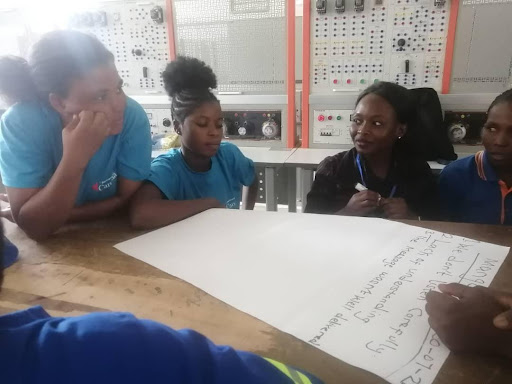
Youth Alive has already supported close to 2,000 young people in offering Vocational Skills Training (VST). More recently, Youth Alive has been granted a four-year (2021-24) contract with WEE-North of Alinea Foundation to train 500 young women at specific technical training institutes because they are unable to continue to higher education due to poor academic results or financial constraints.

ICT is currently investigating ways to support twelve young women between the ages of 18-24 and living in the rural Upper East Region of Ghana, through a similar technical training programme.

Youth Alive: Radio discussions on COVID-19 Protocols + Getting Vaccinated.

As the number of COVID-19 cases began dropping in Ghana in January 2022, the Government,  in consultation with the COVID-19 Management Team and the Ghana Health Service, relaxed restrictions. Unfortunately, in Northern Ghana many people chose to ignore their advice to continue to practise preventative measures and this led to health workers and other health professionals raising serious concerns. There was a call for a more cautious approach and the need to heighten public awareness about the continued existence of the virus and the importance of following the main COVID-19 protocols.

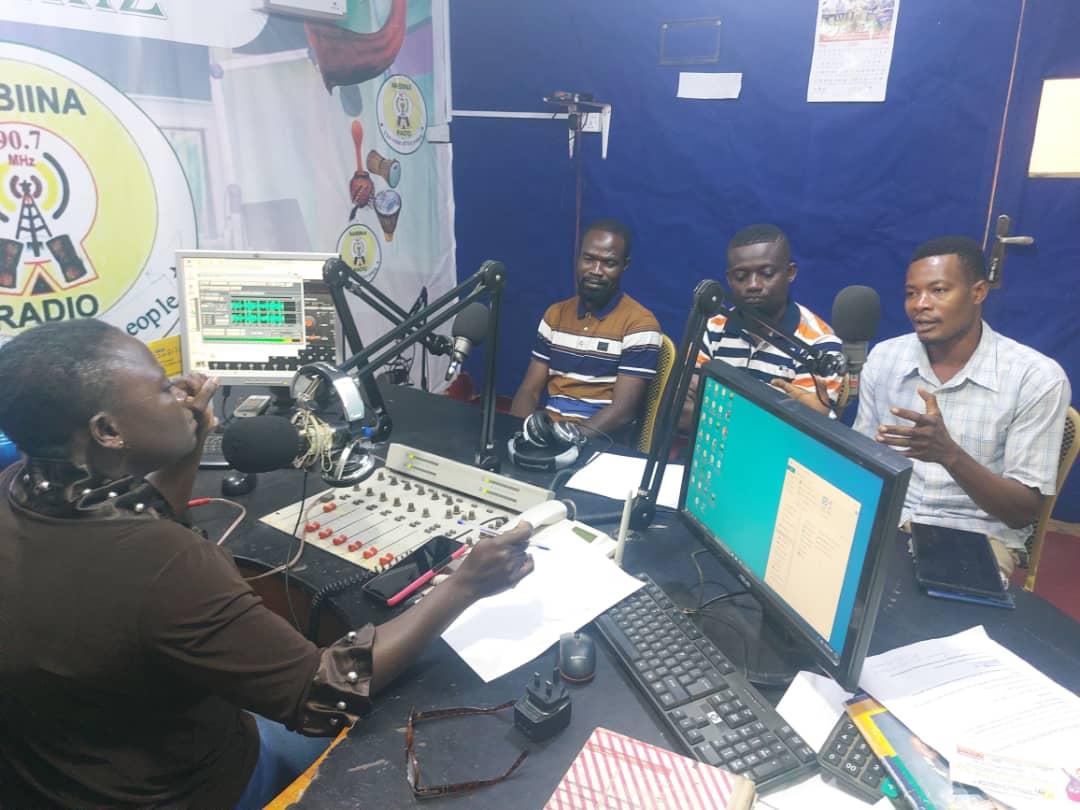
With support from the ICT COVID Relief Fund and the Rotary Club of Coventry, Youth Alive was able to collaborate with the Ghana Health Service and undertake public education to raise awareness in rural communities, through the medium of radio. At three local radio stations, the Ghana Health Service was provided with eight slots of one hour per week for over a month.

The Nabiina Community Radio (FM) broadcasts in the Upper East Region, Lawra FM in the Lawra Municipal area and the Gangaa FM station in the Jirapa Municipal area. Led by the Covid-19 Management team of the Ghana Health Service, these educational programmes were broadcast in the local languages and English. The public had 15 minutes out of the one hour for Q&A for further clarification or to make contributions. In addition, a jingle was written and sung in the local languages. It was played twice a day on the three radio stations to reinforce the message of the programmes. 

Callers appreciated this initiative and the need to remind people of the various precautionary measures that needed to continue to be taken. Both male and female callers used this opportunity to ask the health professionals about the nature of the virus and the possible side effects of the vaccines, particularly for pregnant women. Callers also asked for the location of the vaccination points in their  communities.

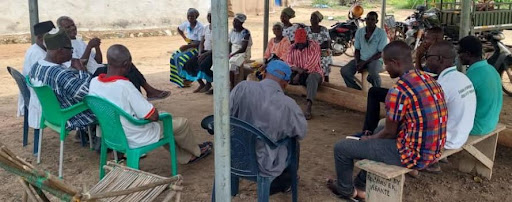
Small community group meetings and house to house visits were also carried out to facilitate and enhance public compliance with the preventative measures. These meetings took place in six communities and a total of 96 people, made up of 52 females and 44 males participated.

Many of those attending the meetings were members of the ‘Community Development Committee’ who had been tasked to spread the message about the radio programmes in their various communities. As a result of this specific project, many people accepted the need to continue to follow the COVID-19 protocols and to get vaccinated.

Youth Alive: Bringing COVID Relief to Rural Children/Youth Communities in Northern Ghana.

In 2019, Youth Alive established two adolescent reproductive health centres in the Kassena-Nankana Municipality of the Upper East region. The purpose of these centres was to strengthen adolescent sexual and reproductive health education by offering easy access to staff, equipment and a welcoming environment for young people seeking such services. A third centre was established in Domwine, in the Lawra district of the Upper West region in 2021.

During the COVID-19 pandemic, there were calls from communities and health workers, particularly in Domwine, to turn the adolescent centres into clinics because apart from sexual and reproductive health services it meant that other medical problems could be treated. This became even more necessary as a preventative measure as there was a need to reduce overcrowding at the main health centres/hospitals due to COVID infections. The Domwine community is quite a distance away from the main health centre. 

The problem remained that although the three centres contributed to a reduction in crowds at the main health facilities, they either lacked or did not have adequate Personal Protective Equipment (PPE) to effectively reduce the risk of infection. This was relevant to both health workers and visitors because they became reluctant to go to the centres. 

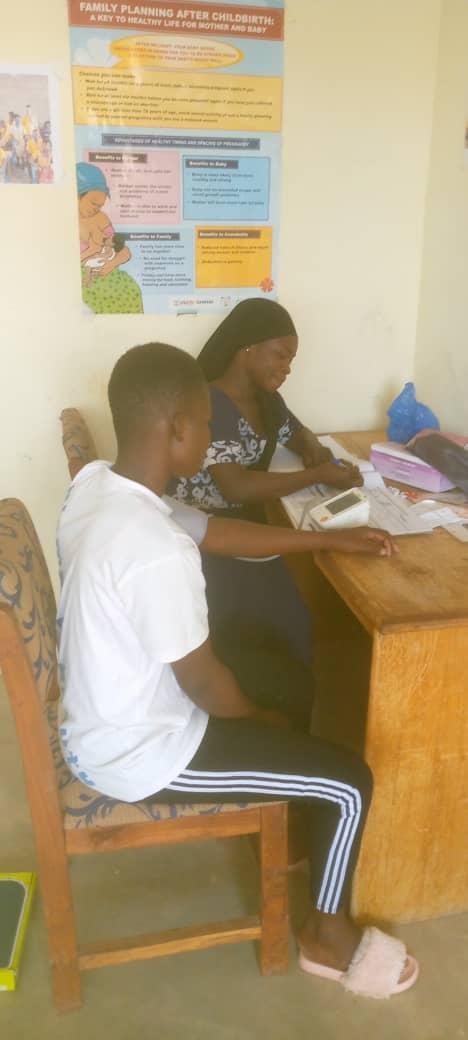
In order to facilitate the protection and safety of young people visiting the reproductive health centres, all three clinics received PPE and other items including; hand sanitisers, liquid soap, face masks, face shields, an infrared thermometer, a blood pressure machine, weighing scales, disposable gloves, rolls of paper hand towels, a Veronica bucket, a Veronica bucket stand, a receptacle for dirty water, a dustbin and dustbin lining.

Thanks to support from the ICT COVID Relief Fund and the Rotary Club of Coventry the provision of PPE and other medical equipment enhanced the service provided by the centres. A community health nurse in one of the centres said, “we have become more efficient since receiving the items. I no longer juggle between the main facility and the adolescent centre for some basic items such as the blood pressure machine and scales.” 

At the same time, there has been a reduction in the spread of COVID-19 and many other diseases due to an improvement in both personal and environmental hygiene. There is now no litter from waste material at the centres because of the availability of dustbins. Previously, waste material used to be dumped on the ground and burnt once in a while. The dustbins are now emptied by a waste management company and taken to approved dumping sites. Frequent hand washing with soap and water is practised at the centres and local school children and communities have been encouraged to do the same at home. 

This practice will be sustained with the aim of inculcating young people and communities to carry out a much improved standard of personal and environmental hygiene beyond COVID-19.

A Success Story from Youth Alive in Ghana.

Milli is fourteen years old and a third year student at junior high school in the rural Upper East Region of Northern Ghana. She is the fifth of six siblings and the only girl in the family. Milli is a bright girl who started school at the age of three. The fact that her older brothers did not perform well at school and dropped out before completing their studies did not motivate Milli’s father to invest time and resources in her education. As he explained, “her older siblings were sent to school and did not prove that formal education was the best way to go” and so he was going to take her out of the education system once she finished primary school. He was also considering arranging an early marriage for her.

While she was at primary school, Milli’s family became reluctant to pay for school books and supplies and this started to have an impact on her performance. However, when she was nine years old, Youth Alive initiated a programme to improve enrolment, retention and performance in local schools and Milli’s community and school both benefitted from this project. The project also provided books and other learning materials to participating schools and to under-resourced children like Milli. Through this project, she was encouraged to join her school club and was selected to become a peer educator benefitting from attending a series of workshops which included ‘Assertiveness Training’, ‘Persuasive Communication Skills’, ‘Rights and Responsibilities of the Child’, ‘Responsibilities of Parents’ and ‘Child Protection and Safeguarding Procedures’. 

This period marked a turning point in Milli’s life. She started to feel more confident, increased her participation in class and her academic performance began to improve. Milli was made the leader of her school club; sharing her learning with her peers during school assemblies. She was also made head girl of her school. During this time her academic performance improved remarkably and she became one of the five best students in her class.

Milli continued to perform well and progress with the same level of confidence during her years at junior high school and represented the school during inter-school debates and quiz competitions. She is currently considered a model student in her school and is studying hard to sit for her Basic Education Certificate exams (BECE) so that she can progress to secondary school.                      

Milli says: “I underrated myself but the training workshops built up my confidence and helped me to realise that I can excel. I want to prove my parents wrong. I am determined to demonstrate to them that I am different from my older brothers and that one day I will change the status of my family. I want to be a nurse in the future so that I can take care of my family’s health needs and also help my community.”

Bird Flu Hits Ghana

Photo of girl adding grain to a container to feed guinea fowl in Ghana

We do not have control over everything that happens.  That certainly seems true with our partners Youth Alive in Ghana.  One of the schools that they work with through our DFID-funded project is Balobia Special School.  Through the support of the Ashworth Trust, the school were able to build a chicken coup to purchase and raise guinea fowl and chickens. The initial purchase of 150 guinea fowl and 150 chickens was providing some excellent nutrition for the children in the school and was part of a programme to encourage their understanding about animal welfare and farming.

Sadly at the beginning of September, we heard that all of the chickens and guinea fowl have died after an outbreak of bird flu that has devastated Ghana.  Families and groups rearing birds is a common enterprise in many African countries, providing a much needed income and as an important source of food.  With bird flu so prevalent in Ghana at the moment, the government have launched a compensation – sadly only for the regions in the south.  With Balobia Special School in the north, it is not eligible for government compensation and so it will take time and, sadly, money to replace the chickens and guinea fowl.

Field Report: Hearing Stories in Ghana

Photo of children with Youth Alive, Ghana writing in the classroom

I have just returned from the North West region of Ghana, where I have seen first-hand how wonderful supporters like you are changing the lives of some of the most vulnerable children in West Africa.

As always, I return from my field visit with mixed feelings.  The work undertaken by our partner Youth Alive is really making a difference in the lives of children.  These children continue to be an inspiration to me and reminds us all at the International Children’s Trust why we feel so passionately about our work.  Sadly, this inspiration is married with feelings of dismay at the poverty I witnessed, and the heart-breaking stories that many people shared with me on my journey.  My hope does remain knowing that our loyal supporters will continue to feel passionately about helping us to change the lives of impoverished families, and give thousands of innocent children the chance to go to school, stay in school, and enjoy their childhood for as long as possible.

Your Support of Youth Alive

Our close partnership with Youth Alive has allowed them to work across 4 districts and 22 communities of Northern Ghana. They are working to remove obstacles to primary and junior high school attendance. Due to high levels of poverty and hardship in these areas, many parents are simply unaware of the importance of supporting their children in their education.

In this region, one of the main obstacles to attending and performing well at school is a high level of violence at home, in the community and in schools.  Children are regularly subjected to beatings, verbal abuse and forced marriage. They are expected to stay away from school to perform tasks at home or to earn income for the family. This is not deliberate cruelty, but a symptom of the lack of education amongst families and the community. You can help us to change that.

Mary’s Story

Amongst all of the stories that I heard in Ghana, one that I will not forget was told by Mary*.  She was in the first years of junior school when, tragically, her mother died. When her father married again, Mary’s new stepmother put her to work running the house, fetching the family’s water and looking after the small crop of vegetables that supported the family. Mary told me how hard her chores were every day. She was unable to manage them as well as going to school – but she desperately wanted an education.

Eventually, the situation came to a head. Mary and her stepmother argued and her stepmother punished her by refusing to give her any food. Eventually, unable to cope, Mary ran away. Like so many children, she became extremely vulnerable and at serious risk of ending up permanently on the streets, with nothing to call her own and nobody to turn to.

Fortunately, one of Mary’s friends was working with Youth Alive as a peer educator. Mary confided in her friend, who immediately turned to Youth Alive to help. Their staff visited the family, spending time and care negotiating with her parents. They explained the importance of education to them and ensured that Mary could return to a safe and encouraging home.

The result of the work of Youth Alive with this family has been profound. Mary’s father and stepmother have become part of the project. They are learning about good parenting and how important it is for Mary to be supported in school. She now attends school every day. Thanks to the intervention of Youth Alive, Mary has the prospect of a bright future, and her parents now understand why education is so crucial for their daughter, and fully support her in pursuing her goals.

Mary’s story demonstrates what makes the approach of International Children’s Trust and all of our partners so unique. When we work with children in desperate situations of domestic violence, we address the root causes of the problem. In so many cases, parents resort to violence and abuse because they simply do not know any better. We support them and show them that there is another way. We highlight the importance of educating their children to break the poverty cycle, and give them practical help to overcome the barriers to achieve that.

We Need Your Support

This Easter, children throughout the UK enjoyed holidays, treats, gifts and celebrations. There are so many children out there, like Mary, who have nothing to look forward to except for another day of grinding poverty, achingly hard work and the threat of violence and abuse. Mary’s story shows us that it does not have to be this way. Every day, we are making a lasting change to the lives of children across the developing world.
Safeguarding Vulnerable Children in Ghanaian Schools

Photo of children at the start of the school term in Ghana

The International Children’s Trust has learned over many years working to bring vulnerable children, from labour or the streets, into education, that school is not necessarily a safe place. Our partner Youth Alive, based in the Upper East region (the second poorest in the country) of Ghana and a practitioner in rehabilitating young children from the streets into school, also found this to be true. During the course of its work, the organisation found that many establishments allowed violent and humiliating forms of punishment to be practiced, causing their young students to suffer harm – often severe physical and emotional harm – whilst in their care and as a result triggering further school dropout. Together with Youth Alive, The International Children’s Trust is changing this. Thanks to support from the UK’s Department for International Development we are now working closely with teachers, parents and communities to utilise positive disciplinary methods and to assert a safe learning environment for all their students. Through this work we can ensure that once in school a child, from the street or from years of underage employment, can feel assured of support in an environment conducive to his, or her, education and can look forward to a more stable and secure future.

We are proud to have extended further work in northern Ghana, where generations of widespread rural poverty have impacted families badly and Youth Alive, with the support of the International Children’s Trust, continues to protect children from child labour, enforced marriage, community and domestic violence and eventual school dropout. In the communities of Biu, Vunania and Gaani, Youth Alive identified children who desperately needed support to attend school. These poverty-stricken regions, where children have to supplement the family income by working long, gruelling hours, and where there are high levels of violence at home and in the classroom, are where often the only option is to drop out of school.

Thanks to support from generous donors we have also provided educational material, uniforms and school fees, as well as skilled support for families, and we are delighted to reveal that 95% of the children benefitting from this project have been able to stay in school, pursue their studies and forge themselves a path to a brighter future. By ensuring that these children remain in education, we are able to protect them from some of the dangers they fall prey to when out on the streets.


Northern Ghana: The facts

  • The Upper East region of Northern Ghana is the 9th poorest of the country’s 10 regions.
  • On average, only one in 5 children attend and/or stay in school beyond grade 5 in Ghana, although figures for the Upper East Region are far worse.
  • Official statistics quote 14% of children in the Upper East aged between 5 and 17 are involved in child labour, although these are likely to be substantially higher in reality.
  • Girls are frequently taken out of school to take care of their siblings or to get married. Boys are also encouraged to drop out to contribute more to the household income.